Mary V. Spiers, professor of psychology (and neuropsychologist) at one of my Alma Maters, Drexel University, has created a brilliant website to clarify the psychological science depicted in the movies.

You must check this out:

I love the review of Finding Nemo. Do you remember Dory, the amnesic sidekick? http://www.neuropsyfi.com/reviews/finding-nemo

For another movie I really enjoyed, Memento, the reviewers point out both the ways in which the movie is accurate in reporting on anterograde amnesia, and inaccurate. http://www.neuropsyfi.com/reviews/memento

The website also has a page devoted to brain science, with information you can actually trust — instead of some of the hyped stuff you might have seen from vendors in the learning field.


I had the great pleasure of being interviewed recently by Brent Schlenker, long-time elearning advocate. We not only had a ton of fun talking, but Brent steered us into some interesting discussions.

———-

He's created a three-part video series of our discussion:

———-

Brent is a great interviewer–and he gets some top-notch folks to join him. Check out his blog.


Sports is sometimes a great crucible for life lessons. Players learn teamwork, the benefits of hard work and practice, and how to act in times of success and failure.

Learning professionals can learn a lot from sports as well. The 2015 Superbowl is a case in point.

Interception

With 27 seconds to go, the Seattle Seahawks were on the New England Patriots one yard line. Only one more yard to go for victory. They called a pass play, rather controversial in the court of public opinion, but not a bad call according to statisticians.

The Seahawks quarterback, Russell Wilson, thought he had a touchdown. “I thought it was going to be a touchdown when I threw it.” Unfortunately for Wilson and the Seahawks, Malcolm Butler, a Patriots rookie cornerback, was prepared.

This is where the science of learning comes in. Butler was prepared for a number of reasons–many having to do with the science of learning. For an explanation of the 12 most important learning factors, you can review my work on the Decisive Dozen.

  1. Butler, despite being a rookie, had played a lot of football before. He had a lot of prior knowledge, which enable him to quickly learn what to do.
  2. He was given tools and resources to help him learn. He got a playbook, he was able to view videotape of Seahawks' plays, he was surrounded by experienced players and coaches, he was motivated and encouraged.
  3. He was given feedback on his performance–but not just general feedback, very specific feedback on what to do.
  4. He got many practice opportunities to refine his knowledge and performance.
  5. Perhaps most importantly, Butler was prompted to make a link between a particular situation and a particular action to take.

Here's the formation prior to the interception. Notice on the bottom of the image that the receivers for Seattle are "stacked" two deep–that is, one is lined up on the line of scrimmage, one is behind the other.

Interception-Set


Here is what Butler saw just as the play was getting started.

What Butler Saw

Here's what Butler said:

“I saw Wilson looking over there. He kept his head still and just looked over there, so that gave me a clue. And the stacked receivers; I just knew they were going to throw. I don’t know how I knew. I just knew. I just beat him to the point and caught the ball.”

In a separate interview he restated what he saw:

“I remembered the formation they were in, two receivers stacked, I just knew they were going to [a] pick route.”

From a science of learning perspective, what Butler did was link a particular SITUATION (two receivers stacked) with a particular ACTION he was supposed to take (move first to where the ball would be thrown). It's this cognitive linking that was so crucial to the Superbowl victory–and to human performance more generally.

While we human beings like to think of ourselves as proactive–and we are sometimes–most of our moment-to-moment actions are triggered by environmental cues. SITUATION-ACTION! It's the way the world works. When we are served food on smaller plates, we eat less–because the small plates make the food look bigger, triggering us to feel full more quickly. When we drive on a narrow street, we drive more slowly. When we see someone dressed in a suit, we think more highly of that person than if they were dressed shabbily. We can't help ourselves. What's more, these reactions are largely automatic, unintended, subconsciously triggered. Indeed, notice Butler's first quote. He wasn't sure what made him react as he did.

In the Decisive Dozen, I refer to this phenomenon as "Context Alignment." The notion is that the learning situation ought to mimic or simulate the anticipated performance situation. Others have similar notions about the importance of context, including Bransford's transfer-appropriate processing, Tulving's encoding-specificity, and Smith's context-dependent memory.

Indeed, recently a meta-analysis (a study of many studies) by Gollwitzer and Sheeran  found that "implementation intentions"–what I prefer to call "triggers"–had profound effects, often improving performance compliance by twice as much as having people set a goal to accomplish something. That is, creating a cognitive link between SITUATION and ACTION was often twice as potent as prompting people to have a goal to take a particular action.

Butler was successful because he had a trigger linking the SITUATION of stacked receivers with the ACTION of bolting to the point where the ball would be thrown.

Situation-Action

Listen to football players talk and you'll know that the best teams understand this phenomenon deeply. They talk about "picking up the keys," which is really a way of saying noticing what situation they're in on the field. Once they understand the situation, then they know what action to take. Moreover, if they can automate the situation-action link–through repeated practice–they can take actions more quickly, which can make all the difference!!

Here's how Butler talks about his preparation. When asked in an interview, "You said you knew that play was coming. How did you know that play was coming?" Butler said:

"Preparation in the [fan?] room, looking over my play book, looking over their plays, studying my opponent. I got beat on it at practice … last week, and Bill [Coach of New England Patriots] told me I got to be on it. And what I did wrong at practice I gave ground instead of just planting and going. And during game time I just put my foot in the ground, broke on the ball and beat him to the point."

For those of us working in the learning field, we should use this truth regarding the human cognitive architecture to design our learning programs.

  1. Don't just teach content.
  2. Give them tools to help them link situations and actions.
  3. Give your learners realistic practice, that is practice set in real-world situations.
  4. Give them feedback, then give them additional practice.
  5. Continually emphasize the noticing of situations, and the actions to be taken.
  6. Provide varied practice situations, without hints, to simulate real-world conditions.
  7. For critical situations, give additional practice to automate your learners' responses.
  8. Collect Lombardi Trophy or similar…

As a resident of New England, I have to add one more nugget of wisdom…


Go Patriots!

Patriots


Sources of Football Information, Images, Videos:

  1. Reuters
  2. NBC
  3. Boston Globe
  4. New York Times
  5. http://nflbreakdowns.com/malcolm-butlers-interception-wilson-superbowl/
  6. http://www.nfl.com/videos/new-england-patriots/0ap3000000467843/Butler-and-Edelman-go-to-Disneyland


There are so many confusions and mythologies on learning objectives that I thought I’d create a video to help disambiguate some of the worst misinformation.

Here is the video. Below the video, I have created a quiz so you can challenge and reinforce your knowledge. Watch the video first, then a day or more later–if you can manage it–take the quiz. Or, take the quiz first, then immediately watch the video–only later, after a few days, look at the quiz feedback.

——


——

Take the Quiz —

Before or After Watching the Video

——


This article was originally published in Will’s Insight News, my monthly newsletter.

It has been updated and improved to include new information.

Click here if you want to sign up for my newsletter…

Radically Improved Action Planning
Using Cognitive Triggers to Support On-the-Job Performance

Most of us who have been trainers have tried one or more methods of action planning–hoping to get our learners to apply what they’ve learned back on the job. The most common form of action planning goes something like this (at the end of a training program):

“Okay, take a look at this action-planning handout. Think of 3 things from the course you’d like to take away and apply back on the job. This is critically important. If you feel you’ve learned something you’d like to use, you won’t get the results you want if you forget what your goals are. On the handout, you’ll see space to write down your 3 action-planning goals. I’m going to give you 20 minutes to do this because it’s so important!”

Unfortunately, that method is likely to get less than half the follow-through that another–research based–method may get you!

When we as trainers do action planning, we are recognizing that learning is not enough. We want to make sure that all of our passionate, exhaustive efforts at training are not wasted. If we’re honest with ourselves, we know that if our learners forget everything they’ve learned, then we really haven’t been effective. This goes for e-learning as well. There’s a lot of effort that goes into creating an e-learning course–and, if we can maximize the benefits through effective action planning, then we ought to do it.


Before sharing with you my radically improved action-planning method, it’s critical that I motivate it. Look at the above diagram. It shows that the human mind is subject to both conscious and sub-conscious messages. It also shows that the sub-conscious channel is using a broader bandwidth–and when humans process messages consciously, they often filter the messages in ways that limit the effectiveness of those messages.

One of the most important findings from psychological research in the past 10 years–I hate to call it “brain science” because that’s an inaccurate tease–is that much of what controls human thinking comes from or is influenced by sub-conscious primes. Speed limit signs (conscious messages to slow down) are not as effective as narrowing streets, planting trees near streets, and other sub-conscious influencers. Committing to a diet may not be as effective as using smaller dishes, removing snacks from eyesight, and shopping at farmer’s markets instead of in the processed-food isles of grocery stores.

We workplace professionals tend to use the conscious communication channel almost exclusively–we think it’s our job to compile content, make the best arguments for it’s usefulness, and share information so that our learners acknowledge its value and plan to use it. But, if a large part of human cognition is sub-conscious, shouldn’t we use that too? Don’t we have a professional responsibility to be as effective as we can?

My action-planning method does just that. It sets triggers that later create spontaneous sub-conscious prompts to action. I’m calling this “Triggered Action Planning”–a reminder that we are TAP-ping into our learners’ sub-conscious processing to help them remember what they’ve learned. SMILE.

The basic concept is this: We want learners, when they are back on the job, to be reminded of what they’ve learned. We should do this by aligning context–one of the Decisive Dozen research-based learning factors–in our training designs. We can do this by using more hands-on exercises, more real work, more simulations–but we can extend this to action planning as well.

The key is to set SITUATION-ACTION triggers. We want contextual situations to trigger certain actions. So for example, if we teach supervisors to bring their direct reports into decision-making, we want them to think about this when they are having team meetings, when they are discussing a decision with one of their direct reports, etc. The SITUATION could be a team meeting. The ACTION could be delegating a decision, asking for input, etc., as appropriate.

In action planning, it’s even simpler. Instead of just asking our learners what their goals are for implementing what they’ve learned, we also ask them to select situations when they will begin to carry out those goals. So for example:

  • GOAL: I will work with my team to identify a change initiative.
  • SITUATION-ACTION: At our first staff meeting in October, I will work with my team to identify a change initiative.

Remarkably, this kind of intervention–what researchers call “implementation intentions”–has been found to create incredibly significant effects, often doubling compliance of actual performance!!!!!!!!!!!!!

I think this research finding is so important to workplace learning that I’ve devoted a whole section of my unpublished tome to considering how to use it. Instead of using the term “implementation intentions”–it’s such a mouthful–I just call this trigger-setting.

The bottom line here is that we may be able to double the likelihood that our learners actually apply what they’ve learned simply by having our learners link situations and actions in their action planning.

New Job Aid for Triggered Action Planning

You can easily create your own triggered-action planning worksheets or e-learning interactions, but I’ve got one ready to go that you can use as is–FREE OF CHARGE BECAUSE I LOVE TO SHARE–or you can just use it as a starting point for your own triggered-action-planning exercises.


Click here to download the triggered-action-planning job aid (as a PDF)

Click here for a Word version (so you can modify)


Research:

Gollwitzer, P. M., & Sheeran, P. (2006). Implementation intentions and goal achievement: A meta-analysis of effects and processes. Advances in Experimental Social Psychology, 38, 69-119.

Bjork, R. A., & Richardson-Klavehn, A. (1989). On the puzzling relationship between environmental context and human memory. In C. Izawa (Ed.) Current Issues in Cognitive Processes: The Tulane Floweree Symposium on Cognition (pp. 313-344). Hillsdale, NJ: Erlbaum.

Roediger, H. L., III, & Guynn, M. J. (1996). Retrieval processes. In E. L. Bjork & R. A. Bjork (Eds.), Memory (pp. 197-236). San Diego, CA: Academic Press.

Smith, S. M., & Vela, E. (2001). Environmental context-dependent memory: A review and meta-analysis. Psychonomic Bulletin & Review, 8, 203-220.

Thalheimer, W. (2013). The decisive dozen: Research review abridged. Available at the Work-Learning Research catalog.

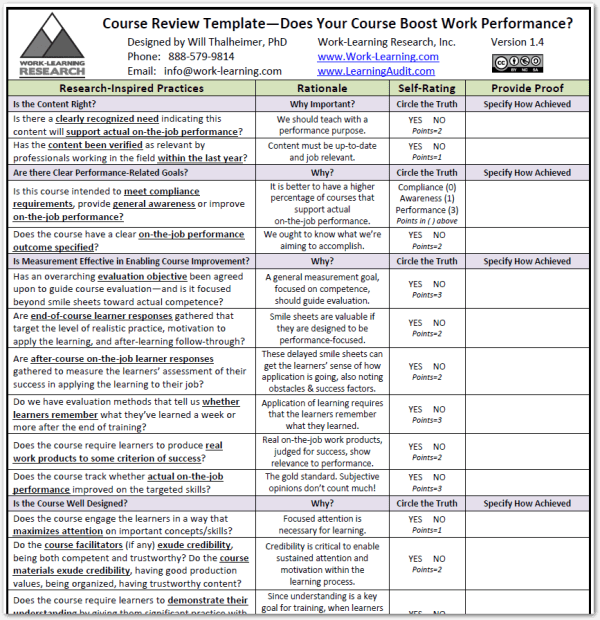
Last week I launched the website LearningAudit.com to promote the practice of learning audits.

LearningAudit_Banner_2014

It is my passionate belief that our learning interventions would be tremendously improved if we took a research-based systematic approach to reviewing them. LearningAudit.com is dedicated to the proposition that we can all do this.

On the site there is the research-to-practice report, "How to Conduct a Learning Audit" and a job aid to support the learning-audit process.

The Course Review Template is a research-based job aid that helps us review our training courses–whether classroom or elearning–to get a sense of the effectiveness their designs.

Representative Comments:

Great provocation. We’re a training provider and scored a “typical” client assignment (20-21). Lots of food for thought for conversations with our clients about what they can do to improve the value they get from our training and follow-up!

The CRT does an excellent job at evaluating using the most important measures.

This template made me deeply aware of all of the variables that we often do not even consider as we work to improve our training courses. The number of questions, and their wording, made it difficult to pad the score.

Updated for 2014

The Course Review Template was just updated and is now available in its new incarnation. One change is that it’s now utilizing a creative commons copyright, making it easier for you to use in your organization.

Indeed, you’re welcome to make changes in the PDF or in the following Word format.

Help Support the Further Development of the CRT

After you’ve used the Course Review Template, complete the feedback form to record your results and send me feedback. Thanks! (UPDATE 2017: We’re no longer collecting feedback through a survey format.)


The spacing effect is one of the most potent learning factors there is–because it helps minimize forgetting.

Here’s a research-to-practice report on the subject, backed by over 100 research studies from scientific refereed journals, plus examples. Originally published in 2006, the recommendations are still valid today.

Click to download the research-to-practice report on spacing.   It’s a classic!


And here’s some more recent research and exploration.

Eric Mazur, who I had the pleasure of meeting several years ago in his on-campus office, won the Minerva Prize, which is dedicated to rewarding "extraordinary innovation" in teaching.

Mazur, a professor of physics at Harvard University, developed the peer instruction method out of frustration with his students’ erroneous conceptions of physics. Too many of them utilized naïve mental models about the physical world in thinking about physics. Mazur wanted them to think like physicists. Unfortunately, his early attempts to improve their physics thinking had failed. He found that just presenting correct concepts was not effective in modifying his students’ faulty mental models.

Mazur’s Peer Instruction method begins with a question designed to surface misconceptions. Learners answer the question, and then talk with their classmates, before a class-wide discussion is engaged. By recognizing and confronting misconceptions, Mazur is better able to help his learners build correct physics conceptions.

To learn more about peer instruction:

  1. Read Mazur's Book (which is focused on how to teach physics)
  2. Look at some research
  3. Read about it on Wikipedia
  4. See Mazur on YouTube (this is very funny at times!)
  5. Read about the Minerva Prize on the Boston Globe
  6. Read Peer Instruction Blog by Julie Schell


I created a list of eLearning Paradigms to talk about subscription learning, but I think the list could stand on its own–and I'd like comments to see what I've missed.

Our Thinking on eLearning is Still Evolving 500px

Elearning is still a relatively young field, having its start in the 1960's during the advent of the computer age and gradually gaining a critical mass after the internet became a mass phenomenon. Because it's a young field, we are still learning how to think about elearning. With each new paradigm, we think more deeply, more fully about what elearning is–and can be. Below is my categorization of the most important elearning paradigms as of 2014.

eLearning Paradigms 2014

  • Content Presenter (enables content to be presented to learners)
  • Comprehension Tester (enables learners' knowledge to be tested–and feedback provided)
  • Practice Provider (enables learners' decision-making to be tested–and feedback provided)
  • Performance Supporter (enables performers to be prompted toward action)
  • Reminder (enables learners or performers to be reminded to learn and/or take action)
  • Social Augmentation Provider (enables learners to learn from and with each other)
  • Gamification Provider (provides motivational incentives and behavioral prompts to action)
  • Mobile Learning Provider (provides learning and/or performance support through mobile technology)
  • Data Utilizer (enables data collection and data-based interventions)
  • Video Provider (enables video to be utilized in various ways)
  • Learning Organizer (provides organizational structure around learning opportunities)
  • Personalizer (enables content or prompting to be individualized or tailored)
  • Learning-Delivery Augmenter (enables easy delivery of content or prompting) 
  • Context-Based Triggerer (enables content or prompting to be delivered depending on context)
  • Cost Saver (enables learning to be delivered at a lower cost)

I'm sure that I'm missing some elearning paradigms. You might have noticed that I'm only listing elearning memes that have a positive connotation. I am not mentioning such things as boring, trivial, poorly-designed. Also, some of the list may not be true, or may not always be true. For example, I've recently read research that shows that elearning is not often a cost saver. The bottom line, however, is that the list above represents a good number of the ways in which we tend to think about elearning.

Here's the thing: The paradigms listed above represent the dominant mental models we use when we think about elearning. As Thomas Kuhn wrote many years ago, paradigms are a double-edge sword. On the one hand, they help us think. On the other hand, they put boundaries on what we think. For us in the learning field, we get both benefits and costs from our elearning paradigms. They help us consider ways that we might design or utilize elearning. On the darker side, they constrict our thinking. One of the reasons we created the eLearningManifesto was to get the field to think beyond some of its weaker paradigms.

What are your thoughts on the dominant elearning paradigms?

If you want to learn more about subscription learning–offered as an additional paradigm for elearning, you can do that at SubscriptionLearning.com.