I've been gathering a list of Myths that the Business Side Has about Learning.
I reached out to my clients, to groups in LinkedIn, to my Brown Bag Learning participants. I also reviewed some books, including Stolovitch & Keeps "Telling Ain't Training"; Doyle's "The Manager's Pocket Guide to Training", Bell's "Managers as Mentors". I also brought to memory my own recollections from over a decade of work and research on learning.
I compiled a list of about 140 myths and then used a card-sort methodology to separate them into categories.
Here are the results:
Everybody Hold Myths
First, it became clear that the Business Side isn't the only group that holds myths. Learners and we as Learning Professionals have our own sets of myths. We can't demonize the Business Side. We have to go out of our way to understand and work with the business side to craft workable effective solutions for our organizations and all the people impacted.
Let me say that sometimes I kind of regret that a distinction has to be made between us as learning professionals and them as the business side. There's something wrong with that distinction (we are IN the business aren't we), yet the dichotomy makes some sense since we support others who do the actual work of the business.
The Most Popular Myths
(that the Business Side Has about Learning, according to Learning Professionals)
These are in order from my card-sorting categorization effort. The most-often cited are listed first.
- Bad Learning Designs are Thought to be Good Learning Designs (big list below).
- Training Alone Produces Improvements in On-the-job Performance.
- Information Presentation is Sufficient as a Training Design.
- Training & Instructional Design Require No Special Skills or Competencies.
- Learners Know How to Learn.
- Managers Think Learning & Development �is a Low-Priority Part of their Role.
Other High-Importance Categories
- On-the-Job Learning is Forgotten or NOT Utilized or NOT Supported.
- It’s a Training Issue (a conclusion drawn before considering alternative causes).
- Formal Training has Little Impact.
- Experienced Workers Don’t Need Training.
- Development of Learning Interventions is Easy and Can be Shortened or Short-Changed.
- Measurement of Learning. Miscellaneous Issues thereof.
- Technology is Key to Learning Success.
Will's and Other Additions
- Learning Designs Don’t Need to specifically Minimize Forgetting (Enable Remembering).
- Content Doesn’t Need Validation.
- Particular Behaviors are Easy to Learn (e.g., It's easy to do customer service).
- Learning is Always Beneficial. It is Never Disruptive or Distracting. It Never Misinforms.
- Opportunity Costs of Learning Can be Ignored.
- We Don’t Have to Measure Learning.
- We Have to Measure ROI. �
- We can Avoid Measuring Retrieval.
Short List of the Bad Learning Designs that the Business Side (and others I might add) Think Are Good Learning Designs
- It is good to have new employee take all their elearning
courses right away before starting work.
- Employees ONLY learn by doing.
- Reading is always bad, boring, and ineffective.
- Training can be just as effective if we make it as short as
possible.
- Training doesn’t need pre-work or post-work.
- A large library of courses or books is the way to go.
- Employees need to know everything.
- We should and CAN cater to learning styles.
- Latest management craze (provide book to everyone).
- Six-hour online courses are fine.
- Some learning media are inherently better than other
learning media.
- Best value in training is a 10 to 12 hour day.
- More information = More learning.
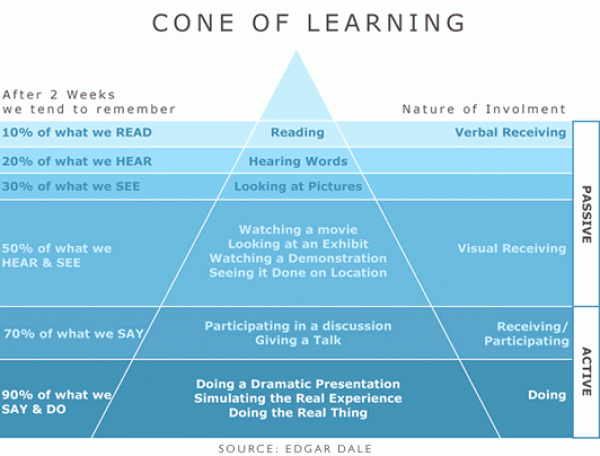
- People remember 10% of what they read, 20% of what they see…
- Most communication is by body language (57% is body
language, only a small fraction communicated is in the actual learning
messages).
- We need more exciting visual decorations to grab attention.
- Immediate feedback is always best.
- Etc.
The MOST IMPORTANT QUESTION: What do we do?
The first thing to do is to demonize everyone and give ourselves kudos for our wisdom, conscientiousness, and whimsical charm.
No.
The first thing to do is to take responsibility. Just as a speaker must take responsibility to ensure that his or her listeners are understanding the intended message (even though much is out of the speaker's control), we must take responsibility for ensuring that our business stakeholders (1) understand learning at a deep level, (2) understand how they can ensure that training is applied successfully on the job, and (3) understand how they can create a work-learning environment that supports employees in learning on their own, from each other, and from their managers.
I got started on this myth gathering as a way to help me build a course for a client (a very large company) to help them improve work-learning at their company top to bottom, including formal and on-the-job learning.
Will this be easy? No. Someone today at my Brown Bag Webinosh asked, "Haven't we been trying to bust these myths for decades?" Great question, and it goes to the difficulty of the task. Many of us have been trying for decades to make changes, but I think also that many of us are just doing our little part as order takers. We build learning interventions when asked. So, bottom line is that I think we could try harder. That's the first thing.
We need to try smarter as well. I've learned over the years, when I've tried to communicate complicated research-based information, that it is critical to find just the right metaphor, just the right visual model, just the right explanation that is both simple and robust to get the job done.
Maybe human learning and performance is just too complicated to enable this, but I think it's worth a try to build some better metaphors, models, and explanations.
We also need to continue to offer research, real-world examples, and valid evaluation results as evidence. We also need to understand our business partners and their mental models and build our case within their frameworks, so they get what we're saying. We need to build into our training-development process our stakeholder-education efforts and our stakeholder-understanding efforts.
Reaching Out
If your company has created a learning intervention to help your business managers better understand learning and their role in it, I'd love to learn more. Contact me.
If your company would like to utilize or co-develop such a learning intervention, feel free to contact me now.
Complete Lists of Myths That the Business Side Has About Learning
(according to Learning Professionals)
(Note that these are offered "as is" with typos, etc.)
- "learning" is the accountability of the Training
or Development Department or staff, rather than a leadership responsibility
- 1 and done – one class and they'll know everything
- 1 or 2 day management training seminar can turn an
ineffective manager in to a high performing one.
- A best practice is to "get all the PPLs out of the
way"
- A business gives a metrics pass to the learning group
because “that stuff can’t be measured” and is then puzzled.
- A learning buffet (large library of courses) is the way to
go
- A learning group is not integrated with those responsible
for performance support.
- a test is need to prove the learners
""know"" it
- Any set of questions will do. There is no need to check to
see which ones are good measures and which are not.
- Anyone can train someone else therefore anyone can create a
training course.
- Asking a performance leader (someone good at their job) to
deliver on the job training should not diminish that performer's output
- Bad Learning Designs are Thought to be Good Learning Designs
(big list below).
- best value in training is a day 10 or 12 hours long.
- Build it and it will run: it's vital to get IT involved
- Build it before or without any needs assessment.
- Butts in seats is all that matters
- Content Doesn’t Need Validation.
- Context doesn't matter; just teach everyone the right steps
to a task
- Courses without organizational support are okay.
- customer service is easy to teach.
- Delivering or presenting instructional content (via ILT or
online courseware) is sufficient to elicit improved performance in the
workplace.
- Different media create different learning results.
- Don't bother with objectives; just present the content.
- E-learning development is fast
- e-Learning isn't learning.
- E-Learning takes 1/3 the time of classroom instruction, so
it should only cost 1/3 as much to create
- electronic learning is just as effective as in person
learning
- Employees can't manage their own learning successfully
- employees need to know everything.
- Employees only learn by doing.
- everyone learns the same way (often the way that the manager
best learns
- Everyone learns the same way, so only one style of learning
is required..
- Experienced Workers Don’t Need Training.
- Facilitators can develop great courses
- Formal (scheduled, structured, SME-created) learning
interventions are the best means of conveying knowledge and skills to our
workforce
- Formal Training has Little Impact.
- Getting certified by taking a training class alone
- Hands-on training is okay if it just enables
situation-actions
- Help mgmt solve problem, not just do workshop
- I already know it so I don't need to go to training.
- I attended a training class so I don't need to practice it.
- I attended a training class so I must know how to do it.
- I don't have to take part.
- I don't need to go through training, I just need my people
to
- I know everyone had different learning styles, but I learn
hands on.
- I left them a to-do list–they should follow it. No follow
up required.
- I need new folks to start immediately. No time for training.
- I should see immediate results on my bottom line the first
day after training
- idea sharing is a good form of learning
- If ""they"" can do it,
""they"" can train it.
- If I tell all of my people what to do in a meeting, they'll
do it and won't need reminders or additional training
- If someone doesn't know how to do something I will just do
it myself because it's faster than teaching
- If someone is trained on something they will be able to
easily figure out how to apply it to their current job without any guidance
- 'if we build it they will come
- I'll figure it out on my own so therefore I don't need to go
to training.
- I'm a Director/VP so I don't need to go.
- I'm a visual learner – I can only understand it if I see it.
- in hard economic times it makes sense to cut training.
- Information makes for learning
- Information Presentation is Sufficient as a Training Design.
- Interactive eLearning is only for Gen X or younger. Older
folks won't get it.
- It has to be interactive
- IT training still needs vaildation if the training is
presented from a task point of view. Must ensure that the steps taught are the
steps needed to complete the task.
- It’s a Training Issue.
- Its a training issue
- It's better if I just have someone show them how to do it.
- It's easy for people to change if you train them right
- It's okay for the training function to be order takers.
- I've been promoted so I don't have to go to training.
- Just send me the handouts/training materials and I'll figure
it out.
- Lack of cultural sensitivity for global audiences
- Lack of performance results mostly from lack of skills or
knowledge.
- latest management book or craze (providing book to everyone)
- Learners have misconception that they don't have
responsibility to go beyond listening.
- Learners Know How to Learn.
- Learners know what they need
- Learning Designs Don’t Need to specifically Minimize
Forgetting (Enable Remembering).
- Learning Development is Easy and Can be Shortened or
Short-Changed.
- Learning does not happen outside the classroom
- learning is a luxury.
We hired smart people. Just work.
- Learning is Always Beneficial. It is Never Disruptive or
Distracting. It Never Misinforms.
- Learning P's. don't understand that learning happens on the
job.
- Learning should not take a lot of time away from work. And people should be able to do self-study
for almost everything
- Learning/Training is the responsibility of other departments
— NOT the responsibility of the managers.
- Let's give them a book or seminar on the topic and they'll
be all better.
- Live virtual programs (LVC) are most effective when they are
recorded without an audience and made available for playback
- Managers think it's more valuable to create multiple SMEs as
opposed to structured learning.
- Managers Think Learning & Development is a Low-Priority
Part of their Role.
- Measurement of Learning Misc. Issues.
- Money not available
- More information provided, more learning.
- more/better training will solve the problem
- Most communication is by body language (55%) and tone of
voice (37%) rather than choice of words (7%). [This is a bastardization of
Mehrabian's studies.]
- My reports went through e-learning. I don't need to do more.
- My time is valuable, I don't have time to take a training
class.
- need a class [to practice the stuff]; I already read it
- Non-business people shouldn’t be involved in business
decision making
- Not just test scores!
- On the job training happens without structure or reward or
cost
- one size fits all" approach
- Only paper and pencil tests (i.e., multiple
choice/true-false) are adequate for regulatory purposes to prove that the
learner has mastered the content.
- On-the-Job Learning is Forgotten or NOT Utilized or NOT
Supported.
- Opportunity Costs of Learning Can be Ignored.
- Other High-Importance Categories
- Particular Behaviors are Easy to Learn.
- People can learn how to use software from a cheat sheet.
- people can learn without being made self-aware about their
own level of competence.
- people know "how" to learn
- People's overall learning doesn't matter, I just want them
to do the task right
- Performers should be assessed immediately after they have
received the content from an instructor or from a courseware program.
- PowerPoint with narration is good enough.
- PPL completion rate is the way to measure quality of
training.
- PPLs and in-store activities are useless – we need to do
hands-on training "instead".
- presentation = training
- Pyramid.
- Quantify and communicate the value
- Reading is always bad, boring, ineffective.
- Regulatory and credentialling agencies create good tests.
- Reports generated by a Learning Management System (LMS) are
sufficient for monitoring the learning-to-assessment-to-performance continuum
in our workplace.
- Role plays are a waste of my time.
- Seen IT buy ""learning"" w/o consultitng
HR or Training dept
- Six-hour online courses are just fine. i.e. no
acknowledgement of information overload erasing what is learned.
- SME's are the best trainers, and Trainers are always the SME's":
Pulling an SME to deliver training just because they know the most isn't always
the most effective approach.
- SME's or developers make the best (or even competent)
trainers.
- So often what is perceived by mgmt as good training is
attributed to the skills of a good presenter, not to training design.
- successful performance during training usually results in
improved otj performance.
- Technology is Key to Learning Success.
- Technology is key to learning success.
- Tell me what I need to know and that's enough.
- tell once, people know it.
- tell them and they'll do it.
- Telling is all we need to do."
- Telling somebody once means they will remember it AND apply
it to their work.
- That "presentation" = "training".
- That stakeholders will see imediate results (i.e. less than
1 year).
- The best way to design is to use the "present and test
method"
- The biggest myth is that training alone will change people's
behaviors.
- The business believes that they can put an employee through
training (be it live, web-based, etc.) and magically they will automatically
put the skills into place
- the course alone will solve the problem
- the HR as a service provider model gives problems as your
'client' is your customer – and the customer is always right
- The more slides, the better (death by PowerPoint)
- The only way to learn is on-the-job-training; spending money
on training programs is a waste
- The skills of instructional designers and educators are
pretty shallow and their key abilities are primarily related to instructional
technology.
- the training department can't help – they don't know our
side of the business
- the training is bad
- there are learning styles
- There are way too many PPLs… but we need a PPL on
_____________.
- There is no special knowledge needed to teach, design, or
organize training
- They can learn all they need to know in (pick arbitrary unit
of time)
- they don't realize the importance of reinforcement, repeat
sessions, follow up
- They have a college degree so they already know it.
- They need a course in order to learn
- Think in-person learning is more effective than online
- too busy
- Training & Instructional Design Require No Special
Skills or Competencies.
- Training Alone Produces Improvements in On-the-job
Performance.
- Training can be just as effective if we make it as short as
possible (one day instead of three days)
- training course will solve the problem.
- Training determines job content and tasks, not the
supervisor or work center.
- training doesn't need follow-up
- Training doesn't need pre-work or post-work
- Training done to replace what managers should be doing
- training fixes everything
- Training is a cheap-quick-easy solution to a problem with my
people
- Training is common sense.
- Training is the responsibility of the organization that
sponsors it and the trainer who delivers it.
- Training is time consuming and does not produce results
- Training isn't very important in my responsibilities.
- Training Just Happens
- Training takes too long.
- Training will automatically change behavior on the job
- Training willing workers creates willing and able workers.
- Training/teaching/telling = learning
- Trainings are luxury and sometimes seen as a cookie for the
staff at a time no one really need it. Let them have some legal fun
- Try again, make sure you use the Access Code that is showing
and follow by a # sign.
- verbal responses (for example to customers) are easy.
- We can Avoid Measuring Retrieval.
- we can send them an email.
- We can train people to do anything…
- we can train people to instantly recall anything.
- We can use common sense to guide training design.
- We can't bring in outside help – our industry is too
specialized and our needs are too unique.
- We Don’t Have to Measure Learning.
- We don't have to look at the performance situation.
- We don't have to validate our content.
- We don't need to learn! We just need to prove we meet the
regulation.
- We don't need to practice. Just tell them.
- We have no time allocated for training in our budget so it
doesn't happen (mgr may not realize that a lot of training happens on the job –
not only as a formal process where the employee sits at the computer).
- We Have to Measure ROI.
- We only hire people who know what they are doing, they don't
need to learn anything, and if they do, they'll pick it up on the job
- we should automatically assume that an SME is ipso facto
'the best trainer'.
- We should/can cater to learning styles.
- When things are not going well it is clearly a lack of
skills and knowledge – so TRAIN them
- Why explain to all levels of employees how the organisation
works, how the departments relate to one another, etc
- Why would I train my employees if they are already doing it?
- Why would I want to train my employees in specific
sub-skills
- You can develop a perfect course without SMEs.
- you can fix anything with enough training.
- You can’t teach people relationship skills (either they have
them or they don’t)
- You don't need objectives, any one can write training.
- You either have the ability to learn or not.
- You have competence or not, then you learn it on the job.
- You need to use a technology to train people properly
Ideas Participants in My Brown-Bag Learning Event Offered on What We as Learning Professionals Ought to Do about the Myth Problem
(Note that these are offered "as is" with typos, etc.)
- Our responsibility – gently guide. Present the right solution when asked for the wrong one
- Give examples of whether X type of intervention has been successful
- Offer performance solutions: this is what we can do (beyond training)
- Bring out the research to dispel the myths
- Develop solid business acumen and work, plan, collaborate from there
- to educate clients
- We need to discuss the learning models and theories that we support when appropriate
- We should be advocates for learners
- We should questions their thinking, ask for evidence
- Provide real evidence of success.
- educate, communicate, inform
- We have to walk a fine line between sticking to the ""truths"" we know, yet dealing tactfully with management's myths.
- myth busters
- Don't be an order taker
- I have found that the RIGHT manager can make a difference. Sometimes change can come from within, by working to influence a middle manager.
- SHOW OUR VALUE
- Have proof/case studies of effects of good design and guidance.
- Don't wait to be invited to clarify them. Anticipate the reality and invite yourself to the table.
- Sell our clients on our skills and recommendations. It keeps coming down to convincing management about the value of what we have to offer.
- As learning professionals we need to promote the effort to focus on what is needed to improve performance.
- To have a clear focus and mission for learning in our organizations, and to be able to communicate clearly, with supporting information.
- Dealing with these myths is our reality and part of scoping a project and defining target and objectives realistically… all the time…




You must be logged in to post a comment.