If you're going to the eLearning Guild's Learning Solutions Conference this coming week in Orlando, come join me–and say hello!

I'll be speaking in three sessions:

Featured Session (F2)
Subscription Learning: A Fundamentally Different Form of eLearning

Time: Wednesday March 19, 10:45AM

Details on the session

Slides for the session

Over 300 people are expected to attend. Get there early for a good seat!

Concurrent Session (105)
Serious eLearning Manifesto (Also with Clark Quinn and Michael Allen)

Time: Wednesday March 19, 1:00PM

Details on the session

We will hand out paper version of the Manifesto at the session (there are no slides)

Morning Buzz (MB31)

Time: Thursday March 20, 7:15AM

A casual conversation about the eLearning Manifesto and Instructional Design

Note: Look for Clark Quinn, or Michael Allen's name (as mine is not listed), but I'll be there!


Yesterday March 13, 2014 (25 years and 1 day after the internet was born) the Serious eLearning Manifesto was released. As one of the "authors" of the Manifesto, I am overwhelmed by the outpouring of passion around the issue of elearning's unrequited promise. Below I will share some of the endorsement statements so that you can see first-hand the dedication of folks in the elearning field.

Manifesto Overview Graphic

The Manifesto

The Manifesto is an attempt to provide people and organizations in the elearning industry a lever to radically raise the effectiveness of elearning.

  • Helping elearning buyers (CLO's, training managers, CEO's, Deans, School Superintendents) demand better elearning, by pointing to the Manifesto's 22 principles as ideals to be achieved or worked towards.
  • Helping elearning designers and developers by providing design and deployment guidance.
  • Helping elearning vendors guide clients to better elearning designs.
  • Helping elearning shops find the leverage to get resourcing and support for truly effective elearning.
  • Helping graduate schools provide guidance on curriculum decisions.
  • Helping trade organizations develop credentials, provide workshops, and make programming decisions.


To read the manifesto or to become a signatory and endorse it:

eLearningManifesto.org


To see the Manifesto release video:

Manifesto Release Video


First-Day Endorsements by Signatories

150x150xSerious-eLearning-Signatory

You can read these and more–and see who wrote them–by clicking here.

"I wholeheartedly agree with, and endorse this manifesto.  This is what is needed to turn the eLearning industry around and on it’s head, so that eLearning can be meaningful and appropriate to meet the needs of users and their educational requirements."

"This Manifesto finally puts what the eLearning professional strives for into a concise format that can be used as a daily commitment to quality."

"It is important that each of us, in our own organizations as well as our own personal commitment, strive to improve our industry and set higher standards. The Manifesto is a step towards this goal."

"What really speaks to me are the principles that have been outlined. There are many ideals here that I have tried to live up to, then there are those I want to live up to, and a few that I haven’t yet thought of to explore. In a time when budgets often are the first thing that matter in organizations, it’s more and more important to prove and show your worth and value to an organization.  Implementing these principles into each of the solutions that we create for our organizations will and can only solidify our true value."

"The work we do in helping people learn is ‘sacred’ work. If we just create content heavy, learning poor courses we fail in our responsibility."

"The manifesto is based on solid, empirical evidence that supports what we should be doing when we build our e-learning."

"It’s not about training – it’s about performance. I agree with the manifesto."

"People know what lawyers and accountants do and how to buy from them as providers of professional services. e-learning is a younger and far more misunderstood industry. The manifesto codifies what good practice looks like and I hope that we can build from this to giving learners great experiences that shift organisational performance."

"I commit to developing eLearning that falls in line with the Serious eLearning Manifesto. I also commit to encouraging others on my immediate team and in my organization to commit to these principles."

"I endorse the principles of the eLearning Manifesto and believe the importance of using these principles to ensure eLearning meets the amazing potential available for real learning to solve real problems."

"Bravo!  Finally an ‘agile manifesto’ for the eLearning community.  These principles will help all of us focus on performance rather than design ephemera…and stay relevant."

"These principles and guidelines are helpful to not only remind eLearning designers and developers of the important aspects of creating effective eLearning. It also helps us by providing support when we need to explain our new designs to clients."

"The eLearning Manifesto represents a step forward for the field of eLearning.  It accurately reflects the vision we, as eLearning developers,   need to adopt in order to move away from ineffective practice and towards the realization of eLearning’s full potential."

"Exquisitely concise and pragmatic! Implementing even a fraction of the ideas in the Manifesto will make a dramatic difference in the kind of eLearning coming into the world."

"I heartily endorse this manifesto. It supports the research that is available and the 22 guiding principles will definitely lead us as practitioners to develop higher quality learning events."

"I’ve been frustrated with bad eLearning for years.  If clients, stakeholders and subject matter experts agree to follow our lead and accept these principles we can finally improve performance.  Furthermore, my hope is that the authoring tools we use adopt these principles in the development of their software."

"I’m a TV producer new to the eLearning industry and every single point you’ve made is exactly what we’ve been saying to our clients.  It’s fantastic to see these values backed up by industry heavyweights who have done the background research to prove their points. The eLearning industry SO needs to be disrupted because so many content suppliers seem to have an attitude that says, "Hey, I know the courses we’re building are based on tech levels from the 70s but that’s what the buyers want.  And we’re making pretty good dough, so ix-nay."  Really? Thank you so much for calling out the complacency in the eLearning industry. Long live the Manifesto."

"The eLearning Manifesto provides a solid foundation on which all eLearning content should be created. If you’re wondering why your eLearning is not producing positive results – odds are you are not following the guiding principles in the Manifesto."

"I am a television and online video producer and new to the elearning world. My first task was to investigate current standards and what I found transported me twenty years into the past to the dawn of Power Point. The manifesto is clearly needed for learners, the end users, the audience, those that are here to be engaged by the content we design and create for them to improve their lives. Thank you for your dedication to a positive  elearning experience and creating a manifesto that puts elearning on a new path to a bright and exciting future."

"I vow to hold the Serious eLearning Manifesto as the new standard for all eLearning modules produced by our eLearning team. We are committed to interactive, real life scenarios and simulations for improved performance on the job.  Now, the Manifesto will help us make our design and development more powerful in our workplace!"

"It is tremendous that four great practitioners took time to formulate these principles and best practices! In addition, the list of Trustees is a "Who’s Who" of eLearning. This initiative will be a great boon to set standards of quality in our field!"

"The Serious eLearning Manifesto says in writing what we’ve all been whispering to our industry peers for years: eLearning is broken! We’ve had the awareness, knowledge, and skills to fix it for some time, but this coordinated effort and the Manifesto’s principles will boost our desire to act through shared accountability and best practice."

"I have longed to see some recognition of the sorry  state of current eLearning. Certainly there are shining examples of what it can be, but so many examples exist that illustrate how utterly woeful the norm has become. We can do better in meeting the promise that online technology presents us with. The Principles associated with the eLearning Manifesto reflect what we need to start implementing if eLearning is to reach it’s potential. Performance, not content; context, not generic; and consequences, not canned feedback are some of the principles we need to start incorporating as best we can within the constraints imposed in work and education. I wholeheartedly endorse this effort for the sake of this profession."


Andy Jefferson, Roy Pollock, and Cal Wick have done it again–written a book on how to ensure training transfer and business results–and they're going to preview their book (AND OFFER A 20% DISCOUNT) in two webinar's next week.

Book details:

This all-new book was developed in response to readers' and participants' requests for additional cases, tools, and "how-to" guides for maximizing the value of training and development.  It contains 43 cases from a wide range of industries and training types from five continents.

More information and the table of contents are available on Amazon.

No-cost webinars:

March 17th at noon EST and March 18th at 9:00 pm EST.  

Register here –> https://the6ds.webex.com

Attendees will receive a 20% discount code on the book from Wiley.

I've been an observer of elearning for almost 30 years. I've seen brilliant, compelling, effective elearning. I've built some pretty damn good elearning too. And yet, after four decades of human effort to improve elearning, there's still way, way, way too much mediocre elearning created each year.

A lot of us have been grumbling about the sorry state of elearning for a long time. Michael Allen, Clark Quinn, and Julie Dirksen and I have had numerous discussions through the years. Finally, having become so uncomfortable with the unmovable status quo of elearning–and feeling a responsibility to do something, anything–we got together last year to strategize on how we could bend the curve of elearning, to help elearning fulfill its promise.

Next Wednesday, we will reveal the result of our efforts.

You can get a little hint of what we've come up with by the name of the effort's website.

eLearningManifesto.org

In a very real sense, Michael, Julie, Clark, and I are mere compilers of the research and work of many. What we've done is to channel the wisdom of scientific researchers, world-class elearning designers, and elearning thought leaders. We have developed a set of values and principles that great elearning–what we're calling Serious eLearning–should possess. We've reality-checked these principles through the feedback of a representative sampling of the world's best elearning–and learning-and-performance–advocates.

Below, I will share our list of Trustees, but let me conclude by sharing my hopes for this effort:

  • That a serious, persistent, and meaningful conversation begins.
  • That more-and-more of us take responsibility to improve elearning.
  • That elearning developers have a guide for elearning design and deployment.
  • That elearning buyers have a set of guidelines to help them procure effective elearning.
  • That graduate schools emphasize the highest levels of elearning design principles.
  • That trade organizations certify at the highest levels of elearning competency.
  • That elearning lives up to its incredible promise for transforming the lives of students, employees, and citizens of the world.


Trustees: (listed in alphabetic order)

Clark Aldrich
Managing Director
Clark Aldrich Designs, LLC

Cammy Bean
VP of Learning Design
Kineo

Mohit Bhargava
President
LearningMate Solutions (Canada) Ltd.

Tony Bingham
President and CEO
ASTD

Jane Bozarth, PhD
ELearning Coordinator
State of North Carolina, USA

Bryan Chapman
Chief Learning Strategist
Chapman Alliance

Tamar Elkeles, PhD
Chief Learning Officer
Qualcomm

Joe Ganci
CEO
eLearning Joe

Judith A. Hale, PhD, CPT
CEO
The Institute for Performance Improvement, L3C

Jane Hart
Founder
Centre for Learning & Performance Technologies

David S. Holcombe
President & CEO
The eLearning Guild

Larry Israelite, PhD
Vice President & Manager
Corporate Learning and Development

John C. Ittelson PhD
Professor Emeritus
CSU Monterey Bay

Philip G. Jones
VP, Managing Partner
Training Magazine

Karl M. Kapp, EdD
Professor of Instructional Technology
Bloomsburg University, Bloomsburg, PA

Tony Karrer, PhD
CEO/CTO
TechEmpower

Connie Malamed
Learning Strategy Consultant
The eLearning Coach

M. David Merrill
Emeritus Professor
Utah State University

Cathy Moore
Training Design Consultant

Bob Mosher
Chief Learning Evangelist
APPLY Synergies

Koreen Pagano
Learning Consultant

Marc J. Rosenberg, PhD
Marc Rosenberg and Associates

Dr. Allison Rossett
Professor Emerita, Educational Technology
San Diego State University

Roger Schank
John Evans Professor Emeritus, Northwestern University
CEO, Socratic Arts

Patti Shank, PhD, CPT
Author, President, Learning Peaks LLC
Director of Research The eLearning Guild

Eric Shepherd
CEO
Questionmark

Clive Shepherd
Learning Technologist
Onlignment Ltd

Roderick Sims, PhD
Design Alchemist
Knowledgecraft, Australia

Brenda Sugrue, PhD
Chief Learning Officer
Kaplan Performance Solutions

Donald H. Taylor
Chairman
Learning and Performance Institute

Sivasailam Thiagi Thiagarajan
Resident Mad Scientist
The Thiagi Group

Reuben Tozman
CEO
SlideJar Inc.

Ellen Wagner
Partner and Senior Analyst
Sage Road Solutions LLC


21st December 2013

Neon Elephant Award Announcement

Dr. Will Thalheimer, President of Work-Learning Research, announces the winner of the 2013 Neon Elephant Award, given this year to Gary Klein for his many years doing research and practice in naturalistic decision making, cognitive task analysis, and insight learning–and for reminding us that real-world explorations of human behavior are essential in enabling us to distill key insights.

Click here to learn more about the Neon Elephant Award…

2013 Award Winner –   Gary Klein

Gary Klein is a research psychologist who specializes in how people make decisions and gain insights in real-world situations. His research on how firefighters made decisions in their work showed that laboratory models of decision making were not fully accurate. His work in developing cognitive task analysis and his co-authorship of the book Working Minds have provided the training-and-development field with a seminal guide. His recent work on how people develop real-world insights is reorienting the field of creativity research and practice. In 1969 Klein received his Ph.D. in Experimental Psychology from the University of Pittsburgh. In the 1990’s he founded his own R&D company, Klein Associates, which he sold in 2005. He was one of the leaders in redesigning the White House’s Situation Room. He continues to be a leading research-to-practice professional.

Klein is honored this year for his lifetime of work straddling the research and practice sides of the learning-and-performance field. By doing great research and great practice and using both to augment the other, he has been able to advance science and practice to new levels.

One of Klein’s most important contributions is the insight that real-world human behavior cannot always be distilled from laboratory experiments. He has brought this wisdom to firefighting, military decision-making, and most recently to everyday insight-creation.

While we in the learning-and-performance field may focus on Klein’s work on cognitive task analysis as his most important contribution to our field, as we now look to discover ways to support employees in on-the-job learning–what some have called informal learning–Klein’s focus on naturalistic decision-making and insight-development are also likely to be seminal contributions.

For deeply exploring naturalistic decision-making and real-world insight–the workplace learning-and-performance field owes a grateful thanks to Gary Klein.


Some Key Links:


Some Key Publications:

  • Klein, G., & Jarosz, A. (2011). A naturalistic study of insight. Journal of Cognitive Engineering and Decision Making, 5, 335-351.
  • Klein, G. (2008). Naturalistic decision making. Human Factors, 50(3), 456-460.
  • Klein, G. A. (1993). A recognition-primed decision (RPD) model of rapid decision making. In G. A. Klein, J. Orasanu, R. Calderwood, & C. E. Zsambok (Eds.), Decision making in action: Models and methods (pp. 138–147). Norwood, NJ: Ablex.
  • Klein, G., & Hoffman, R. (2008). Macrocognition, mental models, and cognitive task analysis methodology. In Schraagen, J. M., Militello, L., Ormerod, T., & Lipshitz, R. (Eds.). Naturalistic decision making and macrocognition. (pps. 3-25). Ashgate: Hampshire, U.K.
  • Kahneman, D., & Klein, G. (2009). Conditions for intuitive expertise: A failure to disagree. American Psychologist, 64, 515-526.


Click here to learn more about the Neon Elephant Award…

We, the members of the workplace learning-and-performance field, think about our field from time to time. Of course we do.

Here’s what I wonder. How much have our mental models changed in the last 50 years?

That’s too big a question for me to answer right now, but it does raise an interesting question. Today, as I was reading an scientific article (citation below) on how people have insights, the authors reported that, in their study of naturalistic insights, most sudden insights occured when people looked at new data–after having spent a great deal of time before the new data thinking about the issue.

Here’s the thing: We, in our field, haven’t really created new data sets or methodologies too often. Yes, we have Jack Phillips ROI methodology and Robert Brinkerhoff’s Success Case Method–both of which got many of us to rethink what we’re doing–but these methods have been at the results end of the causal chain from learning to performance to results. Important stuff–there is no doubt–but not enough.

When it comes to getting new data about learning engagement, remembering, and on-the-job application; we haven’t seen much innovation in our field.

If the research on insight is right, then without new data (or new methods to gather data in the case of an industry-wide perspective) we will not have breakthrough insights about how to improve our training and other learning interventions.

We need to continue working toward better data-gathering methods.

I think the Performance-Focused Smile Sheet offers a glimmer of hope, but the recent infatuation with benchmarking does NOT.

What have you done recently to help your company get better data about your learning-and-performance initiatives?


Citation for article that triggered this insight:

Klein, G., & Jarosz, A. (2011). A naturalistic study of insight. Journal of
Cognitive Engineering and Decision Making, 5
(4), 335-351.

I urge you to support Elliott Masie's war on frivolous LMS Trademarks. Here's what Elliott wrote in his newsletter:

Help! Defend Learning Field
from Patent Suit! The learning "patent trolls" are at it again. There
is a company called IPLearn that has unfortunately successfully sued over a
dozen learning management system – claiming they have invented many of the core
elements of technology delivered learning.  Sure, they wrote several
clever patents that claim to have created much of the field – and, with an
understaffed patent office, it was approved – though there were many prior
learning and technology implementations.  And, their strategy, which has
worked, is to sue a company – get the discovery and legal costs up and up, and
finally settle for a fee and stock shares.  All, without having invented,
produced or created anything – other than a few patent apps.

I have worked, without fee,
against their efforts several times and now they are at it again.  They
have brought suits against several major LMS companies – and I am asking
Learning TRENDS readers to help gather any manuals, documents or other
experiences you have had with these earlier corporate learning systems:

  • Registrar,” by Silton-Bookman
    Systems.
  • Learning Organization
    Information System (LOIS),” by KnowledgeSoft, Inc.

  • Etude,” by Gerald
    Hollingsworth and GPU, Inc.

  • Continuous Learning System
    (CLS),” by AT&T Global Information Solutions International, Inc.

The lawyers defending against
the IPLearn suit would love to see any samples of anything that describes the
operation or public availability of these systems.  For example: 
user manuals, help files, demonstration videos, brochures, press releases, and
actual program disks/CDs. 

If you can help, would you send
a note to my office at
emasie@masie.com
and we will contact you back.  Many thanks!

While I'm not a trademark expert, and I support people and organizations who truly do create something new and unique, trademarks that aren't deserving hurt our industry and our learners.


21st December 2012

Neon Elephant Award Announcement

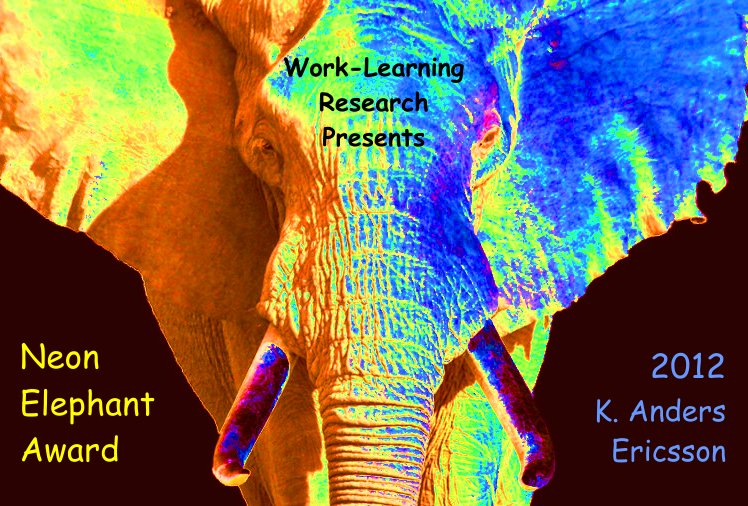
Dr. Will Thalheimer, President of Work-Learning Research, announces the winner of the 2012 Neon Elephant Award, given this year to K. Anders Ericsson for his many years conducting research on expertise and creating a body of knowledge that is so potent that it has inspired many others to translate his research into recommendations for use by performance-improvement professionals.

Click here to learn more about the Neon Elephant Award…


2012 Award Winner –   K. Anders Ericsson

K. Anders Ericsson is Conradi Eminent Scholar and Professor of Psychology at Florida State University. In 1976 he received his Ph. D. in Psychology from University of Stockholm, Sweden, followed by post-doctoral fellowship at Carnegie-Mellon University. Before focusing on expertise, he partnered with Nobel Laureate Herbert Simon in doing seminal research on how human verbal responses can be used in research. Ericsson also partnered with Bill Chase, Walter Kintsch and others in illuminating working memory.

Ericsson is honored this year for (1) his lifetime of research on some of the most important aspects of human cognition and memory, and (2) his seminal work on how people develop expertise. While the Neon Elephant Award is often conferred on (a) practitioners who utilize research, (b) translational researchers, or (c) researchers who create practical models or frameworks, Ericsson is honored for something unique. In his tireless work on expertise, he has created a body of work that has inspired others to translate research into practical recommendations. He didn’t just dip his toes into the field of expertise. He marched for years and years through a torrent of research, creating a ripple effect that has extended into our work in the workplace learning-and-performance field.

We know, based on Ericsson’s work, that people who develop the highest levels of expertise achieve their expertise, not because they were born better, but because they spend an extensive amount of time engaged in deliberate practice. This goes for all types of performers, including musicians, soccer players, doctors, and managers. In deliberate practice, learners are intentionally engaged in improving their skills. They focus concentrated attention in practicing, in getting valid feedback, and in working toward improvement.

The power of Ericsson’s work has inspired others to share the wisdom. Ericsson’s work has been taken up by the Freakonomics guys (Stephen J. Dubner & Steven D. Levitt), by Malcolm Gladwell in his book Outliers, in Dan Coyle’s The Talent Code, and in Geoff Colvin’s Talent is Overrated: What Really Separates World-Class Performers From Everybody Else. Ericsson himself has published (with Michael J. Prietula and Edward T. Cokely) an article on expertise in the Harvard Business Review. 

For laying the foundation for our understanding of expertise–and how it develops–we owe a grateful thanks to K. Anders Ericsson.


Some Key Links:


Some Key Publications:

  • Ericsson, K. A. (Ed.). (2009). Development of professional expertise: Toward measurement of expert performance and design of optimal learning environments.
  • Ericsson, K. A., Roring, R. W., & Nandagopal, K. (2007). Giftedness and evidence for reproducibly superior performance: An account based on the expert performance framework. High Ability Studies, 18(1), 3-56.
  • Ericsson, K. A. (2007). Deliberate practice and the modifiability of body and mind: Toward a science of the structure and acquisition of expert and elite performance. International Journal of Sport Psychology, 38(1), 4-34.
  • Ericsson, K. A. (2006). The Influence of Experience and Deliberate Practice on the Development of Superior Expert Performance. In K. A. Ericsson, N. Charness, P. J. Feltovich, & R.
    R. Hoffman (Eds.), The Cambridge handbook of expertise and expert performance (pp. 683-703). New York: Cambridge University Press.
  • Ericsson, K. A., Charness, N., Feltovich, P. J., & Hoffman, R. R. (Eds.). (2006). The Cambridge handbook of expertise and expert performance. New York: Cambridge University Press.
  • Plant, E. A., Ericsson, K. A., Hill, L., & Asberg, K. (2005). Why study time does not predict grade point average across college students: Implications of deliberate practice for academic performance. Contemporary Educational Psychology, 30(1), 96-116.
  • Ericsson, K. A. (Ed.) (1996). The road to excellence: The acquisition of expert performance in the arts and sciences, sports, and games. Mahweh, NJ: Erlbaum.
  • Ericsson, K. A. (1998). The Scientific Study of Expert Levels of Performance: General Implications for Optimal Learning and Creativity. High Ability Studies, 9(1), 75-100.
  • Ericsson, K. A., & Charness, N. (1994). Expert performance: Its structure and acquisition. American Psychologist, 49(8), 725-747.
  • Ericsson, K. A., & Chase, W. G. (1982). Exceptional memory. American Scientist, 70, 607-615.
  • Ericsson, K. A., & Kintsch, W. (1995). Long-term working memory. Psychological Review, 102(2), 211-245.
  • Ericsson, K. A., Krampe, R. Th., & Tesch-Römer, C. (1993). The role of deliberate practice in the acquisition of expert performance. Psychological Review, 100(3), 363-406.
  • Ericsson, K. A., & Lehmann, A. C. (1996). Expert and exceptional performance: Evidence on maximal adaptations on task constraints. Annual Review of Psychology, 47. 273-305.
  • Ericsson, K. A., & Simon, H. A. (1993). Protocol analysis; Verbal reports as data (revised edition). Cambridge, MA: Bradford books/MIT Press.


Click here to learn more about the Neon Elephant Award…


22nd December 2011

Neon Elephant Award Announcement

Dr. Will Thalheimer, President of Work-Learning Research, announces the winner of the 2011 Neon Elephant Award, given this year to Jeroen van Merriënboer for his many years conducting research on learning and translating that research into practical models for use by learning professionals.

Click here to learn more about the Neon Elephant Award…

2011 Award Winner –  Jeroen J. G. van Merriënboer

Jeroen van Merriënboer is Program director for Research in Education, the research and PhD program of the School of Health Professions Education at Maastricht University (in Maastricht, The Netherlands).  He is also scientific director of the Interuniversity Centre for Educational Research. His main area of expertise is learning and instruction, in particular instructional design and the use of new media in innovative learning environments. He has published widely on four-component instructional design (www.tensteps.info), cognitive load theory, and lifelong learning. He holds several academic awards for his research and has been a supervisor for over 25 PhD students.

His forthcoming book:  

  • Ten Steps to Complex Learning: A Systematic Approach to Four-Component Instructional Design
    (2nd Edition arriving August 2012) 

His recent books include:

  • Ten Steps to Complex Learning: A Systematic Approach to Four-Component Instructional Design
    (2007, with Paul A. Kirschner, First Edition).
  • Training complex cognitive skills: A four-component instructional design model for technical training.
    (1997, winner of AECT’s Outstanding Book-of-the-Year Award)

Selected Publications:

Jeroen J. G. van Merriënboer is honored this year for (1) his lifetime of research and (2) for his exhaustive efforts over the years in bringing research to practice (especially as represented in his Four-Components Instructional Design model (4C/ID) and his book and articles related to the Ten-Step framework (www.tensteps.info)

Jeroen should also be acknowledged for his seemingly inexaustible efforts on many fronts. He’s twice won the Best PhD Supervisor Award by the PhD Student division of the Netherlands Educational Research Association (NERA). He’s Associate Editor for the journal Learning and Instruction (ranked #3 in Educational Psychology and Educational Research). He is, or has been, involved in editorial boards on more than 10 other publications. He is involved in management as a director of research. He runs several funded research projects. He has developed software prototypes. He has authored over 100 articles in scientific refereed journals. He’s been an invited speaker over 100 times.

For his lifetime of work and for his ability to translate complex research findings into reasonably simple models for instructional design, we owe Jeroen J. G. van Merriënboe our most grateful thanks.

Click here to learn more about the Neon Elephant Award…


To view this as a PDF, click here.

————————-

To improve, we must know our biggest failings.

In the training and development field, our five biggest failures are as follows:

  1. We forget to minimize forgetting and improve remembering.
  2. We don’t provide training follow-through.
  3. We don’t fully utilize the power of prompting mechanisms.
  4. We don’t fully leverage on-the-job learning.
  5. We measure so poorly that we don’t get good feedback to enable improvement.

1. Minimizing Forgetting, Improving Remembering

It is not enough to help people understand new concepts or even to motivate them to utilize those concepts. If they don’t remember concepts when they encounter situations in which those concepts would be useful, then previous understanding and motivation is for naught.

There are three powerful mechanisms that support long-term remembering, (a) aligning the learning and performance contexts, (b) providing retrieval practice, and (c) utilizing spaced repetitions. Most of our learning interventions do a poor job of providing these mechanisms—resulting in training that may create awareness but doesn’t support remembering or performance improvement.

We need to give our learners more realistic practice using scenarios and simulations. We also need to space repetitions of learning over time—much more than we do now. Instead of trying to teach everything at a basic awareness level, we need to cover less content—but not just present it—instead giving our learners opportunities for deliberate practice.

2. Training Follow-Through

Providing training but no effort to ensure that learners will apply what they’ve learned is the height of professional malpractice. If we assume that learners remember what they’ve learned (which as we just saw is not a given), learners still must (a) remain motivated to apply what they’ve learned, (b) feel that there is some benefit to applying the learning, (c) have the resources and time to put their learning into practice, (d) get feedback and guidance to improve their performance, and (e) be prepared to overcome obstacles and frustrations in applying the learning.

Note how the first two failures create an additive effect—both significantly lessen the likelihood of on-the-job application of the learning. If learners don’t remember, they’re not going to apply what they’ve learned. If learners don’t receive after-training follow-through support, they are unlikely to provide the continuous and persistent focus needed to apply the learning in a way that creates sustainable success.

To reach a credible level of training follow-through we need to (a) engage our learners managers to enlist their support, (b) provide reminders to apply the learning, (c) provide relearning opportunities for that which has been forgotten, (d) enable additional learning to improve and elaborate on the performance, (e) ensure our learners have the resources and time they need to apply the learning and integrate it into their behavioral repertoire, (f) provide coaching support to guide the learning-and-performance process, (g) ensure the learners are incentivized either tangibly with money or perks or intrinsically by aligning efforts with personal values and sense-of-identity, and (h) encourage persistence even in the face of obstacles and frustration.

3. Prompting Mechanisms

Prompting mechanisms rely on one particularly powerful foible of the human cognitive architecture—that our working memories are triggered easily by environmental stimuli. Prompting mechanisms include things like job aids, performance support tools, signage, intuitive cues in our tools and equipment, and some forms of management oversight. They work because they prompt certain strands of thinking, and thus performance. For example, a job aid that lists 5 key interview goals, 10 key interview questions and their rationales automatically triggers in the interviewer a certain way of thinking about interviewing. For example, an interview template might remind its user that interviews are more telling if interviewees are asked to perform a work task or describe how they would perform a work task. Without such a prompt, the interviewer might focus only on how well they think the person would fit into the work culture, etc.

While we are aware of these prompting mechanisms, we are not aggressive enough in their use. If we utilized prompting mechanisms more often with our training and more often as a replacement for training, we’d create better outcomes. If we went looking for grassroots prompting mechanisms already being used and helped spread their use, we’d be more effective. If we evaluated learning facilitators on their use of prompting mechanisms, we’d be more likely to encourage the use of prompting mechanisms. If we asked learners in training to practice with prompting mechanisms, we’d see more being used on the job—and our learners would remember more of what they learned.

4. On-the-Job Learning

We as learning professionals tend to focus almost exclusively on the creation and delivery of training interventions even when we know that our learners are doing a great deal of their learning on the job without any training. Employees learn through trial-and-practice, getting help from others, through social media, by reading task instructions, by using help systems, and so forth. While we have much less direct influence on on-the-job learning than on training, we do have some influence and we ought to use it if we are serious about getting results.

Often the biggest impact we can have is by accessing managers and encouraging them to actively promote learning. Managers can improve learning in their direct reports by (a) making it a point to monitor their employees’ competencies and guide them toward learning opportunities, (b) being approachable and available for questions and advice, (c) creating a culture of learning and information sharing, (d) encouraging data-driven decision-making instead of opinion-driven decision-making, (e) utilizing an experimental mindset, for example by encourage pilot-testing and rapid prototyping, and (f) giving direct reports time for learning and exploration.

We can also have an influence on on-the-job learning by creating and maintaining social-media mechanisms that can be tailored to particular needs. For example, wikis can be used by project teams to get input from various parties and blogs can be used by senior folks to lay out a compelling vision.
We can encourage better on-the-job learning by improving people’s ability to coach their fellow employees. Too often people asked to coach others do a poor job because they just don’t know what good coaching looks like.

We can utilize diagnostic tools to help people in the organization see things about themselves—or about the organization—that they might not otherwise see. For example, if the organization engages in an effort to improve coaching ability, those being coached can be asked to take a short diagnostic survey on how well their coach is doing in coaching them. If an organization wants to change its culture to one that is more flexible and creative, we can utilize a diagnostic to track progress. We can also use a diagnostic to get the organization talking about specifics—so that employees know what behaviors represent the past culture and which represent the new culture.

There are, of course, other things we can do to directly influence on-the-job learning. In addition, we can change our brand by stopping our tendency to be order takers for training. By changing the way we define our role, we can encourage the business side to be fuller partners in organizational learning.

5. Measurement and Feedback to Spur Improvement

We as learning professionals suck at measurement, creating a vacuum of information that pushes us to make poor decision after poor decision in our learning designs. By only seeking learner opinions about the learning, we encourage a bias toward entertainment and engagement and away from content validity, remembering, and application. By measuring only when the learners are in the training context, we don’t learn whether the learning intervention would generate remembering in a work context that is not like the training situation. By measuring only during the learning event, we measure the learning intervention’s ability to create understanding, but we do not measure the learning intervention’s ability to support long-term remembering. We also fail to examine whether any training follow-through is utilized. By utilizing only low-level questions in our tests of learning, we fail to measure the ability of our learners to make decisions that relate to workplace performance. In short, we don’t get the feedback we need to make good learning decisions.

Maintaining ourselves in a state of permanent darkness, we continue to make terrible decisions in regard to learning design, development, and deployment. We design primarily for engagement and understanding, while ignoring remembering, motivation, and application. We hire and promote trainers and training companies who get great ratings but who don’t help learners remember or apply what they’ve learned. Because our measurement is focused only on training, we fail to engage our business partners to ensure that they are adequately supporting learning application—we also never learn what obstacles and leverage points face our learners when they go to apply the learning in their jobs. We build e-learning programs that encourage learners to focus on low-level trivia instead of focusing on the main points. By abstaining from diagnostics, we leave employees blind to conditions from which they might benefit. Poor measurement enables the first four failures.

The bottom line on measurement is that measurement should provide us with valid feedback. Unfortunately, because we haven’t taken the human learning system into account in our measurement designs—and in our measurement models—we are getting biased information and drawing inappropriate conclusions from poor data.

The Five Failures are Fixable

We as learning professionals—as a whole—though working honorably and with good intentions, are too often failing to maximize our impact. Our job is work-performance improvement. We can start by improving our own work performance.

But instead of focusing on everything—which will certainly overwhelm us—we should focus on the things that really matter. We should focus on our five failures. Instead of following willy-nilly prescriptions that pop like fads from a popcorn popper—we should focus on five things that are fundamental—and inspired by the learning research. We should focus on the five failures.

In this brief article, I have provided strong hints about how to rethink and redirect each of the five failures. While such a brief synopsis is certainly not sufficient to enable you to completely redesign your learning efforts, it should, I hope, motivate you to get started.

————————-

To view this as a PDF, click here.