
Neon Elephant Award 2012
21st December 2012
Neon Elephant Award Announcement
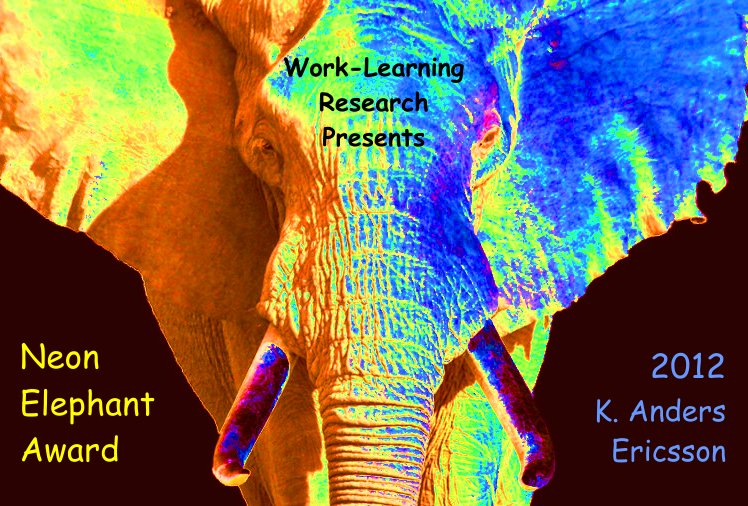
Dr. Will Thalheimer, President of Work-Learning Research, announces the winner of the 2012 Neon Elephant Award, given this year to K. Anders Ericsson for his many years conducting research on expertise and creating a body of knowledge that is so potent that it has inspired many others to translate his research into recommendations for use by performance-improvement professionals.
Click here to learn more about the Neon Elephant Award…
2012 Award Winner – K. Anders Ericsson
K. Anders Ericsson is Conradi Eminent Scholar and Professor of Psychology at Florida State University. In 1976 he received his Ph. D. in Psychology from University of Stockholm, Sweden, followed by post-doctoral fellowship at Carnegie-Mellon University. Before focusing on expertise, he partnered with Nobel Laureate Herbert Simon in doing seminal research on how human verbal responses can be used in research. Ericsson also partnered with Bill Chase, Walter Kintsch and others in illuminating working memory.
Ericsson is honored this year for (1) his lifetime of research on some of the most important aspects of human cognition and memory, and (2) his seminal work on how people develop expertise. While the Neon Elephant Award is often conferred on (a) practitioners who utilize research, (b) translational researchers, or (c) researchers who create practical models or frameworks, Ericsson is honored for something unique. In his tireless work on expertise, he has created a body of work that has inspired others to translate research into practical recommendations. He didn’t just dip his toes into the field of expertise. He marched for years and years through a torrent of research, creating a ripple effect that has extended into our work in the workplace learning-and-performance field.
We know, based on Ericsson’s work, that people who develop the highest levels of expertise achieve their expertise, not because they were born better, but because they spend an extensive amount of time engaged in deliberate practice. This goes for all types of performers, including musicians, soccer players, doctors, and managers. In deliberate practice, learners are intentionally engaged in improving their skills. They focus concentrated attention in practicing, in getting valid feedback, and in working toward improvement.
The power of Ericsson’s work has inspired others to share the wisdom. Ericsson’s work has been taken up by the Freakonomics guys (Stephen J. Dubner & Steven D. Levitt), by Malcolm Gladwell in his book Outliers, in Dan Coyle’s The Talent Code, and in Geoff Colvin’s Talent is Overrated: What Really Separates World-Class Performers From Everybody Else. Ericsson himself has published (with Michael J. Prietula and Edward T. Cokely) an article on expertise in the Harvard Business Review.
For laying the foundation for our understanding of expertise–and how it develops–we owe a grateful thanks to K. Anders Ericsson.
Some Key Links:
- Freakonomics Article in NY Times. A Star is Born.
- Review of Ericsson and His Work in The Australian.
- Wikipage on Ericsson.
- Harvard Business Review, Reprint R0707J
Some Key Publications:
- Ericsson, K. A. (Ed.). (2009). Development of professional expertise: Toward measurement of expert performance and design of optimal learning environments.
- Ericsson, K. A., Roring, R. W., & Nandagopal, K. (2007). Giftedness and evidence for reproducibly superior performance: An account based on the expert performance framework. High Ability Studies, 18(1), 3-56.
- Ericsson, K. A. (2007). Deliberate practice and the modifiability of body and mind: Toward a science of the structure and acquisition of expert and elite performance. International Journal of Sport Psychology, 38(1), 4-34.
- Ericsson, K. A. (2006). The Influence of Experience and Deliberate Practice on the Development of Superior Expert Performance. In K. A. Ericsson, N. Charness, P. J. Feltovich, & R.
R. Hoffman (Eds.), The Cambridge handbook of expertise and expert performance (pp. 683-703). New York: Cambridge University Press. - Ericsson, K. A., Charness, N., Feltovich, P. J., & Hoffman, R. R. (Eds.). (2006). The Cambridge handbook of expertise and expert performance. New York: Cambridge University Press.
- Plant, E. A., Ericsson, K. A., Hill, L., & Asberg, K. (2005). Why study time does not predict grade point average across college students: Implications of deliberate practice for academic performance. Contemporary Educational Psychology, 30(1), 96-116.
- Ericsson, K. A. (Ed.) (1996). The road to excellence: The acquisition of expert performance in the arts and sciences, sports, and games. Mahweh, NJ: Erlbaum.
- Ericsson, K. A. (1998). The Scientific Study of Expert Levels of Performance: General Implications for Optimal Learning and Creativity. High Ability Studies, 9(1), 75-100.
- Ericsson, K. A., & Charness, N. (1994). Expert performance: Its structure and acquisition. American Psychologist, 49(8), 725-747.
- Ericsson, K. A., & Chase, W. G. (1982). Exceptional memory. American Scientist, 70, 607-615.
- Ericsson, K. A., & Kintsch, W. (1995). Long-term working memory. Psychological Review, 102(2), 211-245.
- Ericsson, K. A., Krampe, R. Th., & Tesch-Römer, C. (1993). The role of deliberate practice in the acquisition of expert performance. Psychological Review, 100(3), 363-406.
- Ericsson, K. A., & Lehmann, A. C. (1996). Expert and exceptional performance: Evidence on maximal adaptations on task constraints. Annual Review of Psychology, 47. 273-305.
- Ericsson, K. A., & Simon, H. A. (1993). Protocol analysis; Verbal reports as data (revised edition). Cambridge, MA: Bradford books/MIT Press.